About IMS Noida
Institute of Management Studies (IMS), Noida, established in 1998, is a premier educational institution recognized for its commitment to academic excellence, innovation, and industry relevance. Over the years, IMS Noida has evolved into a dynamic center of higher learning, offering a wide range of undergraduate and postgraduate programs across multiple disciplines.
IMS Noida offers specialized education across a diverse range of disciplines, including:
- Management – Offering programs such as BBA, MBA, and MBA, designed to cultivate future business leaders through a dynamic, industry-focused curriculum.
- Law – Under IMS Law College, Noida, students can pursue integrated and traditional law degrees including BA LL.B, Com LL.B, and LL.B, with a strong emphasis on legal research and professional ethics.
- Information Technology – Providing rigorous technical training through programs like BCA and MCA, preparing students for success in the ever-evolving IT sector.
- Journalism and Mass Communication – Through BAJMC and MAJMC programs, students gain hands-on experience and theoretical insights into the fields of media, journalism, and digital communication.
The institute was founded with the vision of addressing the growing need for professionally trained graduates and postgraduates. Its industry-aligned curriculum, experienced faculty, and emphasis on experiential learning have consistently produced career-ready professionals equipped to lead in a rapidly changing global environment.
IMS Noida’s academic excellence is backed by accreditations from esteemed bodies such as the National Board of Accreditation (NBA) and the National Assessment and Accreditation Council (NAAC). Furthermore, strategic partnerships with leading industry organizations, national bodies, and international universities enrich the learning experience and provide global exposure to its students.
With a strong focus on quality, innovation, and professional development, IMS Noida continues to shape future leaders in the fields of business, law, media, and technology.
Details about the event:
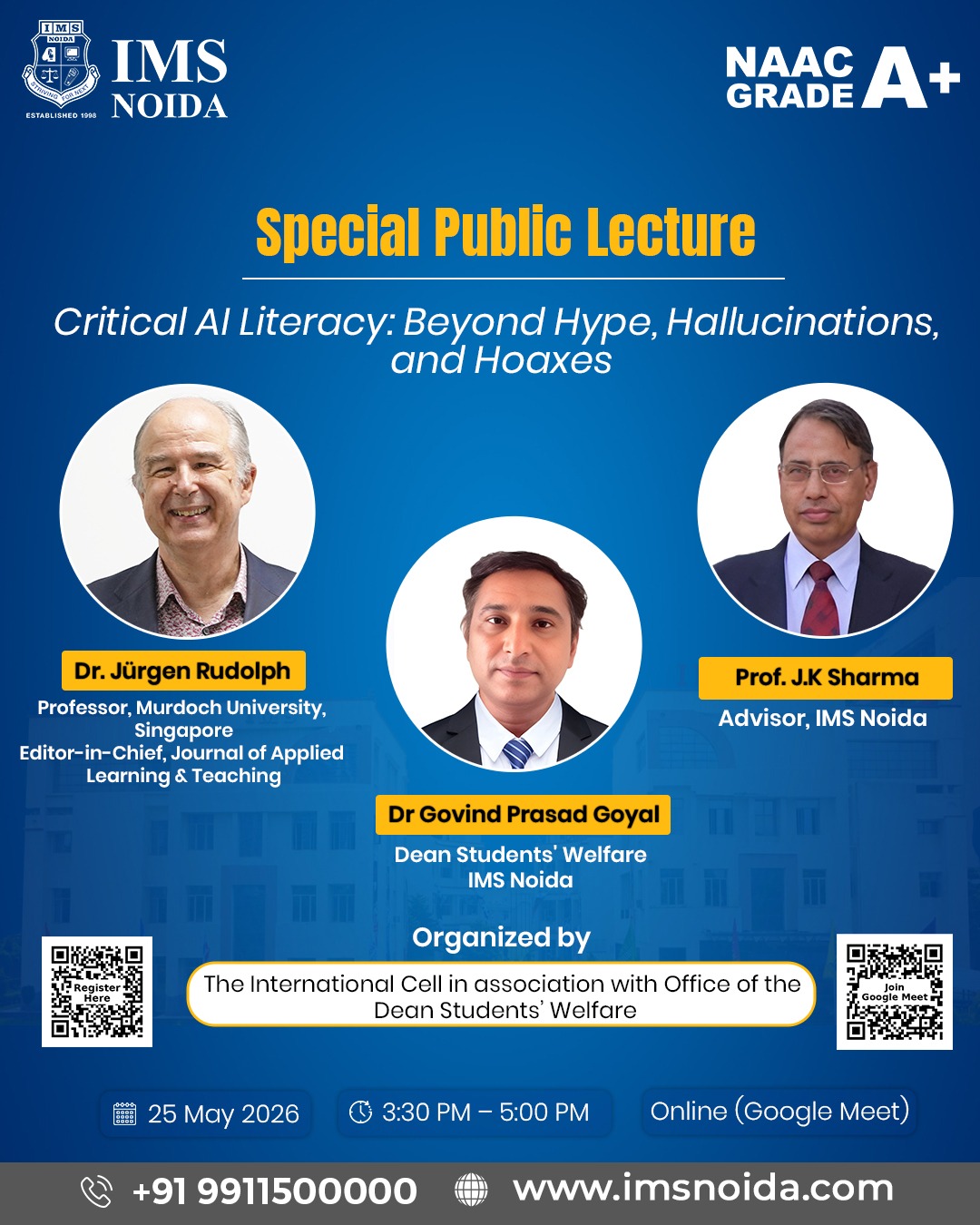
International Public Lecture on Critical AI Literacy: Beyond Hypes, Hallucinations and Hoaxes” on 25 May 2026 (Wednesday) at 3:30 PM IST via Google Meet (Online)
About the programme
Artificial intelligence has become the defining conversation of our era — in boardrooms, classrooms, government corridors, and dinner tables. The claims are extraordinary: AI will transform education, cure cancer, end poverty, revolutionise democracy, and make every worker more productive. Some of those claims contain a grain of truth. Many do not. Almost all of them serve someone’s interests — and it is rarely yours.
This lecture is not a guide to using AI tools. It is an invitation to think clearly about them. Drawing on the speaker’s forthcoming book, Critical AI Literacy: Beyond Hype, Hallucinations and Hoaxes, the talk dismantles myths that dominate current AI discourse, introduces a critical AI framework, and asks what it would mean — for individuals, for universities, and for societies — to govern AI rather than simply adopt it.
The argument is humanist and unabashedly critical. It is also, the speaker hopes, entertaining.
Background
The lecture is based on a book of the same title, completed in 2026. The book brings together critical scholarship in AI studies, education research, political economy, and philosophy to offer a sustained, evidence-based critique of the dominant AI narrative. It is written for academic readers but aimed at anyone who wants to understand what is actually happening — as opposed to what the industry wants us to believe is happening.
The book is structured in two parts. Part 1 dismantles six myths: that AI is genuinely intelligent; that it is autonomous and ‘artificial’ in any meaningful sense; that it benefits humanity broadly rather than concentrating power; that its outputs are neutral and objective; that American technological dominance is permanent; and that AI will create as many jobs as it destroys. Part 2 turns to higher education as a critical arena — examining the ‘AI revolution’ that wasn’t, the unwinnable war on academic dishonesty, and what genuine critical AI literacy looks like in practice.
Key Themes
- The Bullshit EngineLarge language models do not think, understand, or know anything. They predict plausible text. The illusion of intelligence is not in the machine — it is completed by us. Understanding this distinction matters enormously for how we use these systems and what we trust them to do.
- Hype as InfrastructureAI hype is not accidental noise. It is a deliberate strategy: to secure investment, pre-empt regulation, and make scepticism seem like a character flaw. This lecture shows how to read hype critically — and why it matters that we do.
- Who Benefits?The economic architecture of the AI boom is stark: wealth flows overwhelmingly upward, ecological costs flow downward, and the democratic risks — disinformation, surveillance, algorithmic bias — fall hardest on those with the least power to resist them. This is not a side effect. It is a structural feature.
- AI and Higher Education: The Revolution That Wasn’tUniversities under financial strain are unusually vulnerable to technological solutionism. The promised AI revolution in education is largely a category mistake: faster content production is not learning; risk scoring is not pastoral care; automation is not renewal. The evidence for genuine learning gains is thin. The evidence for institutional harm is growing.
- What Critical AI Literacy Actually MeansTraining people to use AI tools is not the same as educating them to understand AI systems. The first project produces consumers. The second produces citizens. This lecture argues for the second — and sketches what it looks like in practice.
- Non Serviam: What We Must RefuseDrawing on James Joyce and Immanuel Kant, the lecture closes with a question that predates generative AI by centuries and will outlast it: what is education for? The answer proposed is not comfortable, but it is, the speaker believes, necessary.
Who Should Attend?
This lecture is designed to be accessible to any intelligent, curious person — regardless of technical background. It will be of particular interest to academics and researchers in any discipline, university administrators and policy makers, educators at all levels, journalists, lawyers, and other professionals navigating AI in their work, students curious about what their institutions are not telling them, and anyone who uses AI tools and wonders whether they should trust them.
No prior knowledge of AI, computer science, or education research is required. Prior scepticism is an advantage.
Speaker’s bio:
Dr Jürgen Rudolph
Dr Jürgen Rudolph has spent three decades in higher education, earning 9,000+ citations (h-index 23). Jürgen holds a PhD (summa cum laude), MBA, MEd, and MA, is a Fellow of the Higher Education Academy, and brings proven entrepreneurial and senior-leadership expertise. As Editor-in-Chief, he lifted the Journal of Applied Learning & Teaching into Scopus Q1 (top 5 % in Education) and has produced 100+ publications on AI, crisis leadership, and pedagogy, amongst other topics. Formerly Director of Research & Learning Innovation of a private education institution in Singapore, he devised institution-wide strategies for teaching, research, and AI adoption, while sustaining high student-satisfaction scores across multiple modules from Sustainability Management to Entrepreneurship. He has chaired 30+ international symposia, built global partnerships, and co-authored Teaching Well (2023). He is co-editor of the Handbook of AI and Higher Education (2026) and Entrepreneurship in Singapore (2026). His work sits at the intersection of critical technology studies, higher education research, and political economy.
Registration form:
Fee details (if any) – REGISTRATION FREE
https://forms.gle/GudwZtqcgweeL12g8
E-certificates to all the registered participants.
Deadline: Register by 24 May 2026 at 11:59 PM
Contact Information-Convener-Prof. (Dr.) Govind Prasad Goyal, Dean Students’Welfare-
WhatsApp no.-+91-997-112-9012
Official link : https://imslawcollege.com/
