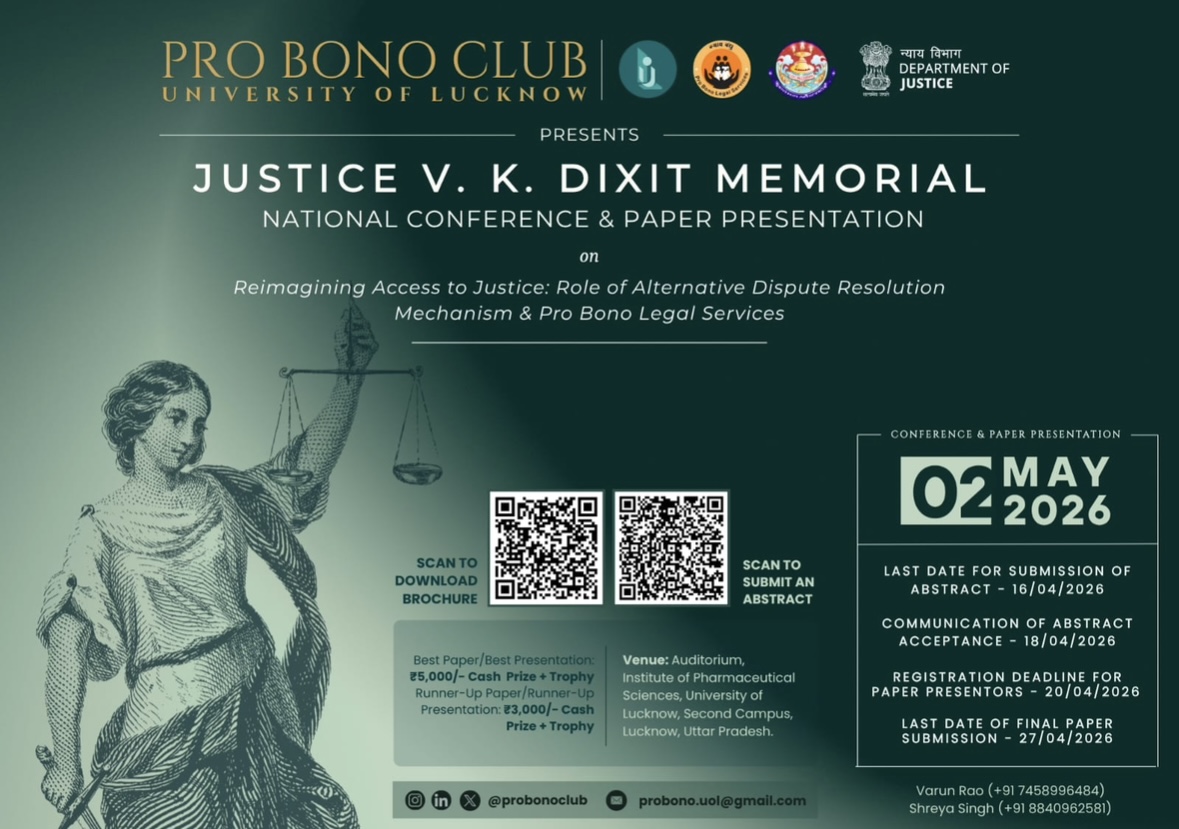
Call for Papers | Justice V.K. Dixit Memorial National Conference & Paper Presentation | University of Lucknow | 02 May 2026
The Pro Bono Club, Faculty of Law, University of Lucknow, is organising the Justice V.K. Dixit Memorial National Conference & Paper Presentation on the theme “Reimagining Access to Justice: Role of Alternative Dispute Resolution Mechanism & Pro Bono Legal Services” on 02 May 2026.
About the Organisers
Established in 2023 under the aegis of the Nyaya Bandhu (Pro Bono Legal Services) Programme of Department of Justice, Government of India, the Pro Bono Club at the Faculty of Law, University of Lucknow, is a government-backed student-driven organisation, committed to strengthening access to justice and promoting the culture of pro bono legal services.
About the Faculty of Law, University of Lucknow
Established in 1921, the Faculty of Law at the University of Lucknow stands among the oldest and most distinguished institutions of legal education in India. The Faculty has been shaped by eminent jurists and academicians, including Prof. R.U. Singh, whose contributions significantly influenced the development of legal education in India. Renowned scholars such as Dr. V.N. Shukla, Dr. A.T. Markose, and Dr. Avatar Singh have further strengthened its intellectual legacy through their authoritative work in constitutional, company, contract law and other laws.
Its alumni network reflects a tradition of excellence, with distinguished figures including Dr. Shankar Dayal Sharma (Former President of India) and members of the higher judiciary such as Justice A.S. Anand (Former Chief Justice of India). The legacy continues today with alumni serving at the highest levels of the judiciary, including the Supreme Court and various High Courts. With a strong academic infrastructure and a commitment to justice-oriented legal education, the Faculty continues to nurture legal professionals who contribute meaningfully across litigation, academia, corporate practice, and public service.
About the Conference
Historically, access to justice has been defined by physical proximity to courts and the availability of legal representation. However, in today’s dynamic legal landscape, justice must transcend geographical, procedural, and economic barriers, through both institutional and alternative mechanisms.
The contemporary discourse on access to justice is undergoing a transformative shift; at the core of this transformation lies the growing prominence of pro bono legal services, which serve as the moral foundation of the legal profession. Despite its deep-rooted presence in Indian legal tradition, pro bono work remains largely unstructured and sporadic. Equally significant is the role of Alternative Dispute Resolution (ADR) mechanisms which are no longer merely an “alternative.” ADR is increasingly being recognised as a primary and efficient pathway to dispute resolution. Nevertheless, critical questions remain regarding its inclusivity, accessibility, and effectiveness.
The Conference seeks to bring together members of the judiciary, academicians, practitioners, and policymakers to engage in meaningful deliberation, propose innovative solutions, and contribute towards building a more accessible, equitable, and responsive justice delivery system.
Participants desirous of attending the Conference without paper presentation may register through the prescribed form: https://forms.gle/HFTezXhLv6csq7YP6.
Last Date for Registration (Conference Attendees): 25 April 2026
Eligibility Criteria
Indicative Sub-Themes
1. Impact and Institutional Framework of Pro Bono and Legal Aid
2. Pro Bono Engagement within ADR Mechanisms
3. Technology, Digital Platforms, and Access to Justice
4. Engagement of the Legal Institutions in Advancing Pro Bono Culture
5. Community-Centric and Grassroots Justice Mechanisms
6. Pro Bono Lawyering and Social Justice
(Authors are free to explore any topic aligned with the main theme)
Submission Process and Guidelines
The submission process for the Conference is structured in the following stages:
Step 1: Abstract Submission
All interested participants are required to submit their abstracts through the prescribed Google Form within the stipulated deadline.
Step 2: Review & Acceptance
All abstracts will undergo a blind review process. The best 24 abstracts will be shortlisted for submission of the paper and presentation at the Conference.
Step 3: Registration and Fee Payment
Authors of selected abstracts will receive an acceptance email along with a registration link. They are required to complete the registration process and pay the prescribed fee within the stipulated timeline to confirm their participation.
Step 4: Final Paper Submission
Upon successful registration and fee payment, authors of selected abstracts will receive a separate email containing the paper submission link. Final papers must be submitted in accordance with the prescribed guidelines within the stipulated deadline. Failure to do so may result in disqualification.
Submission Guidelines
Submit your abstract here: https://forms.gle/ftjoN228fLQruADe7
Final Paper Submission Guidelines
Important Dates
Registration Fee
(Fee includes Conference Kit (entry pass, theme literature, bare acts), Morning Refreshment, Lunch and High Tea, and Certificate of Participation / Presentation)
Awards
Best Paper / Best Presentation: ₹5,000 Cash Prize + Trophy + Certificate of Achievement.
Runner-Up Paper / Runner-Up Presentation: ₹3,000 Cash Prize + Trophy + Certificate of Achievement.
Certificates of Presentation to all author(s) present for the presentation round.
Certificate of Participation to all registered attendees.
Digital Book of Abstracts to all participants/attendees.
Contact Details
Aditya Raj Soni
(Student Convenor, Pro Bono Club)
Bhavesh Kumar
(Student Co-convener, Pro Bono Club)
bhavi16kumar@gmail.com
For any queries or further information related to conference, please contact: Varun Rao – 7458996484; Shreya Singh – 8840962581
For brochure, refer to the official event Google Drive link: https://drive.google.com/drive/folders/1Vtb1DlFe93OoDxJ5ZZxFvU9nC-mb3MD6?usp=sharing
Follow us for real-time updates: Instagram || LinkedIn || X
