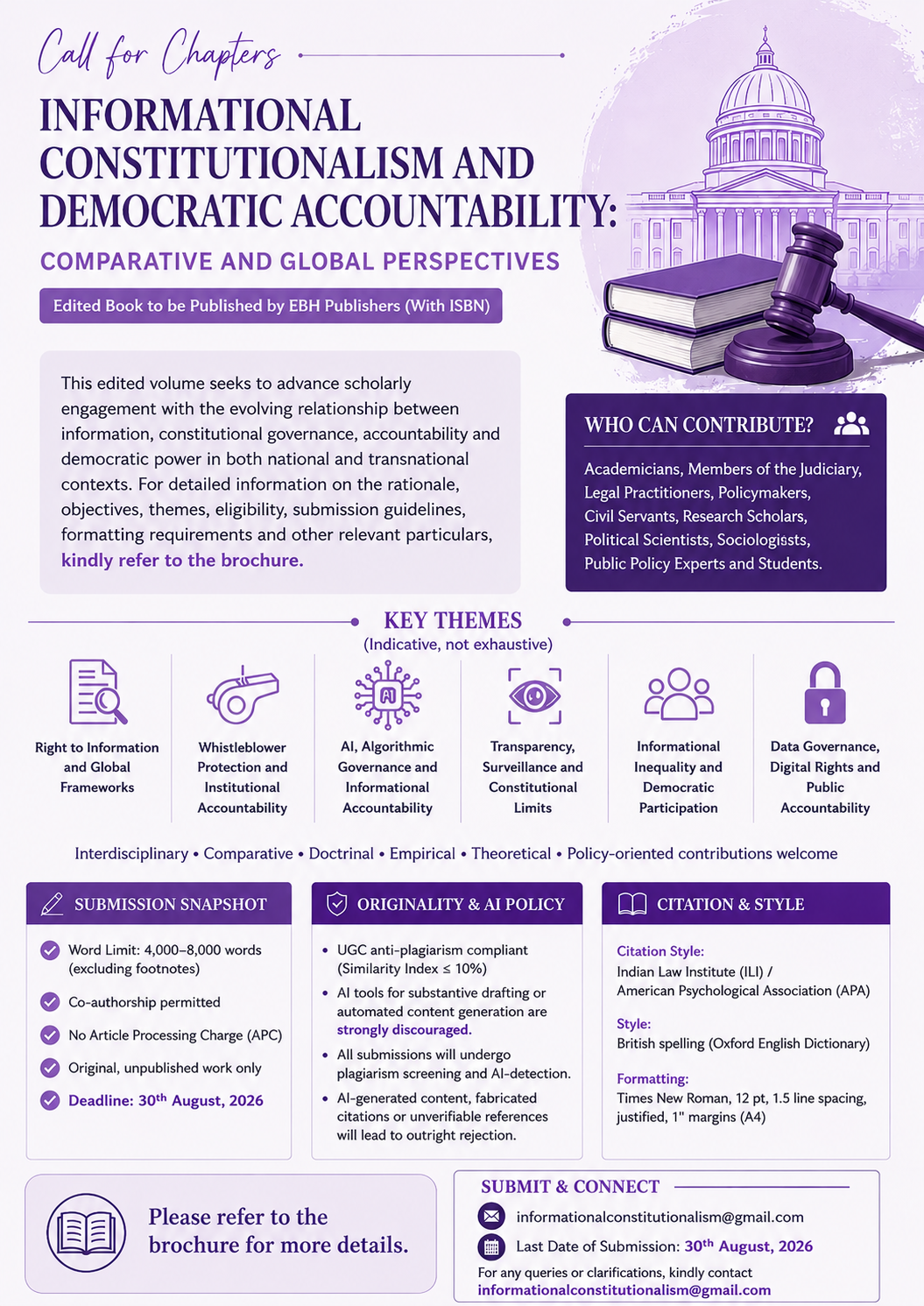
CALL FOR CHAPTERS: INFORMATIONAL CONSTITUTIONALISM AND DEMOCRATIC ACCOUNTABILITY: COMPARATIVE AND GLOBAL PERSPECTIVES
Edited Book to be Published by EBH Publishers (With ISBN)
ABOUT THE BOOK
The twenty-first century constitutional state faces a significant paradox. While democratic governments increasingly rely on technology in the exercise of public power, concerns regarding declining institutional trust, opacity and weakening accountability continue to grow. In this context, transparency has emerged as a foundational constitutional principle linked to democratic participation, public accountability and the rule of law.
The proposed book, Informational Constitutionalism and Democratic Accountability: Comparative and Global Perspectives, seeks to examine the evolving relationship between information, constitutional governance, accountability and democratic power across national and transnational contexts. It explores how democratic societies can regulate informational power while preserving transparency, institutional legitimacy and public trust. Moving beyond a narrow doctrinal understanding, the book aims to develop a broader framework of informational constitutionalism, recognising access to information, institutional openness, accountability mechanisms and democratic participation as central features of contemporary constitutional governance.
THEMATIC AREAS (Indicative & Not exhaustive)
- Theoretical Foundations of Informational Constitutionalism
- Global frameworks on Right to Information
- International Standards on Whistleblower Protection and Institutional Accountability
- Technology, Data Governance and Algorithmic Accountability
- Comparative constitutional approaches to Right to Information
- Right to Information in the Age of Digital Governance Transparency and Surveillance
- Constitutional Limits of State Power for restricting access to information
- Digital Divide, Informational Inequality and Democratic Participation
- Artificial Intelligence, Algorithmic Governance and Transparency in Public Administration
- The “Black Box” Problem: Algorithmic Opacity, Automated Decision-Making, and Constitutional Accountability
- Algorithmic Bias and Informational Justice
- Comparative Perspectives on Technology-Driven Governance and Digital Constitutionalism
- Cybersecurity, National Security and Informational Rights in Constitutional Democracies
- Data Governance, Platform Power and Public Accountability
- Biometric Governance, Digital Identity Systems and Civil Liberties
- Predictive Governance, Automated Statecraft and Democratic Oversight
ELIGIBILITY
The edited book invites original and high-quality contributions from academicians, members of the judiciary, legal practitioners, policymakers, civil servants, research scholars, political scientists, sociologists, public policy experts and students.
PUBLICATION POLICY
There are no submission fees, publication charges, or Article Processing Charges (APCs) for contributions to this volume.
WORD LIMIT
The manuscript shall be between 4000-8000 words, exclusive of footnotes.
SUBMISSION GUIDELINES AND STYLE REQUIREMENTS
Authors are requested to carefully read the detailed submission guidelines, formatting requirements, citation style, originality policy, and publication ethics contained in the official brochure.
The brochure may be accessed here
SUBMISSION PROCEDURE
Submissions must be emailed to: informationalconstitutionalism@gmail.com
IMPORTANT DATE
Submission Deadline: 30th August, 2026
CONTACT
For any queries or clarifications, kindly contact informationalconstitutionalism@gmail.com
Flyer: Access Here
