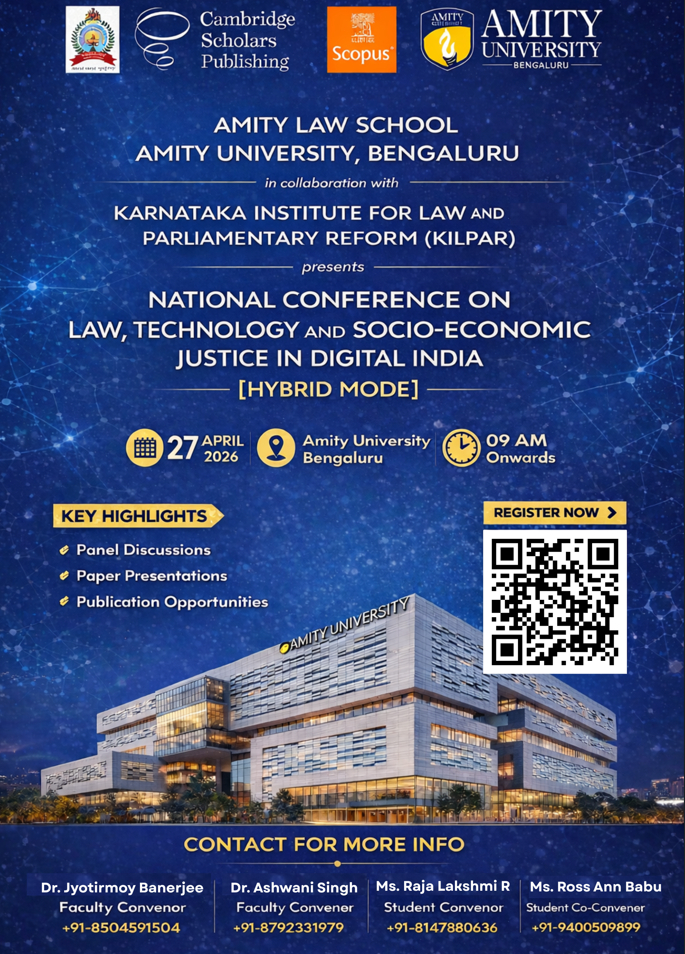
Call for Papers: National Conference on Law, Technology and Socio-Economic Justice in Digital India organized by Amity Law School, Amity University, Bengaluru in collaboration with Karnataka Institute for Law and Parliamentary Reform (KILPAR) on Friday, April 27, 2026 [Hybrid] [SCOPUS Publication]
ABOUT AMITY UNIVERSITY, BENGALURU
Amity University Bengaluru carries forward the globally acclaimed legacy of the Amity Education Group, underpinned by over two decades of commitment to academic excellence, innovation, and global engagement. As a hub of higher education in South India, the university exemplifies Amity’s mission to cultivate future-ready leaders by integrating global standards in education, research, and training with a strong cultural foundation. Spread across a sprawling 70-acre eco-friendly campus, Amity University Bengaluru offers an intellectually vibrant, technologically advanced, and culturally diverse learning environment. The institution is recognized by the University Grants Commission (UGC), ensuring that all degrees awarded are valid for employment and higher education across India and abroad.
ABOUT KILPAR
The Karnataka Institute of Law and Parliamentary Reform (KILPAR) was established in the year 2005, as an initiative of the Department of Law, Justice and Human Rights and Legislation, Government of Karnataka. It is an autonomous institution registered under the Karnataka Society’s Registration Act, 1960. The objectives of the institution are to develop into an advanced forum for reform of law and parliamentary practices, to undertake research in myriad dimensions of law and suggest law reforms, promote research, draft new legislations, play a vital role in bringing about legal awareness and awareness of parliamentary procedure and practices, organize conferences and seminars, undertake publication of research works and similar activities. In pursuance of the objectives the institute has published 85 books based on research, conducted more than 300 seminars on socially relevant law topics in collaboration with universities.
ABOUT AMITY LAW SCHOOL
Amity Law School, Amity University Bengaluru, stands as a premier institution for legal studies, committed to fostering academic excellence, professional competence, and ethical responsibility. With its forward-looking curriculum and student-centric learning environment, the Law School embodies Amity’s vision to create global legal professionals who are socially conscious and justice-driven. Amity Law School offers a range of undergraduate and postgraduate programmes, integrated degrees, and research opportunities in law. Its curriculum is designed to balance classroom teaching with experiential learning. Located at the vibrant Bengaluru campus, ALSB is equipped with state-of-the-art infrastructure, digital libraries, and court-like learning spaces that facilitate comprehensive legal education.
CONFERENCE OVERVIEW
The National Conference on Law, Technology and Socio-Economic Justice in Digital India, organized by Amity Law School, Amity University Bengaluru in collaboration with the Karnataka Institute for Law and Parliamentary Reform (KILPAR), is conceived as a dynamic academic platform aimed at critically examining the transformative interface between law, technology, and socio-economic justice in contemporary India.
The conference seeks to engage with the rapidly evolving digital ecosystem and its implications on legal systems, governance structures, and access to justice. It will explore a wide spectrum of pressing issues including digital economy and consumer governance, fintech and financial inclusion, artificial intelligence in healthcare, bioethics and biotechnology regulation, intellectual property in technology-driven industries, data protection and privacy, digital media accountability, and the emerging challenges of platform governance and digital sanctions.
THEMATIC AREAS OF SUBMISSION
Track 1: Digital Economy, E-Commerce and Consumer Governance
- Cross-Border E-Commerce and Emerging International Trade Regulations
- Consumer Protection and Liability in Online Marketplaces
- Digital Payments, FinTech and Financial Inclusion in India
- Impact of Platform-Based Commerce on Traditional Retail and Small Enterprises
Track 2: Biotechnology, Bioethics and Regulatory Governance
- Intellectual Property Protection in Biotechnology and Life Sciences Innovation
- Legal Regulation of Genetically Modified Organisms and Bio-Safety Frameworks
- Bioethics, Human Rights and Legal Accountability in Biotechnology Research
- Biotechnology for Sustainable Agriculture, Environmental Protection and Food Security
Track 3: Digital Health, Medical Jurisprudence and Emerging Technologies
- Artificial Intelligence and Digital Health Technologies in Medical Practice
- Patient Rights, Informed Consent and Data Protection in Healthcare
- Role of Forensic Science and Digital Evidence in Criminal Justice
- Legal and Ethical Challenges in Telemedicine and Digital Healthcare Systems
Track 4: Technology, Intellectual Property and Creative Industries
- Blockchain and Transparency in Fashion and Creative Supply Chains
- Technology-Driven Counterfeiting and Legal Responses in Digital Marketplaces
- Intellectual Property Protection in Fashion, Design and Digital Creativity
- Artificial Intelligence, Innovation and the Future of Creative Industries
Track 5: Digital Media, Society and Democratic Accountability
- Digital Media, Communication Technologies and Democratic Governance
- Privacy, Surveillance and Data Protection in the Digital Public Sphere
- Role of Media and Digital Platforms in Advancing Social Justice
- Social Media Influence on Public Opinion, Elections and Civic Participation
Track 6: Digital Sanctions, Platform Governance, and Socio-Economic Justice in Emerging Digital Economies
- Legality of Digital Sanctions and Platform Restrictions in International and Indian Law
- Economic Implications of Technology-Driven Sanctions on Digital Markets and Startups
- Algorithmic Governance, Tech Sovereignty, and Geopolitical Power in the Digital Era
- Socio-Economic Justice and the Human Impact of Digital Exclusion Mechanisms
*Submissions outside the above list that resonate with the central theme are equally welcome.
REGISTRATION FEE
Participation in the conference is completely FREE OF COST.
There are NO REGISTRATION FEES for submitting abstracts, presenting papers, or attending the conference.
ABSTRACT SUBMISSION GUIDELINES
All interested participants must submit an abstract before submitting their full papers. The abstract should clearly articulate the research problem, objectives, methodology, and key findings or arguments. Only original abstracts that align with the conference theme will be accepted.
- Each applicant must submit a 250-word extended abstract providing an overview of the proposed paper on the attached Google Form.
- The abstract must be submitted in MS Word (.doc or .docx) format only.
- Each abstract must contain a cover page inclusive of the following details:
- Name(s) of the author(s),
- Designation
- Institutional affiliation,
- Contact number(s) of the author(s),
- Email ID
- A maximum of 5 keywords is to be provided along with the abstract.
MANUSCRIPT SUBMISSION GUIDELINES
- Each author must submit a full manuscript not exceeding 3500 words (inclusive of footnotes).
- The manuscript must be submitted in MS Word format (.doc or .docx) only.
- The manuscript must include a cover page containing the following details:
- Name(s) of the author(s),
- Designation,
- Institutional affiliation,
- Contact number(s) of the author(s),
- Email ID.
- The main manuscript must not contain any identifying information to ensure a blind review process.
- A maximum of 5 keywords must be provided below the abstract.
- The manuscript must include an abstract (upto 250 words) at the beginning of the paper (exclusive of 3500 Words of the final manuscript).
KEY ATTRACTIONS OF THE CONFERENCE
The conference is conceived as a vibrant academic forum bringing together scholars, practitioners, policy-makers, and technology experts to examine how emerging technologies are reshaping legal systems, governance structures, and socio-economic justice in contemporary India.
The key highlights include:
- Scopus Publication Opportunity for Top 5 Papers
- Research Paper Presentation Opportunity
- Dual Publication Opportunities
- Launch of Edited Volume
*Note
- All paper presenters and contributors shall be awarded Certificates of Participation.
- Contributors who present their papers in person at Amity University, Bengaluru shall be eligible for a Certificate of Presentation, while those who do not present shall be issued a Certificate of Participation.
- Further, non-presenting contributors may still be considered for publication in the edited book/conference proceedings, subject to the discretion of the Organising Committee.
- The authors of the Top 5 selected papers may be required to submit a extended version of their manuscript, subject to the requirements and review process of Cambridge Scholars Publishing.
AWARDS & RECOGNITIONS
To acknowledge excellence in legal research and scholarly engagement, the conference will confer the following awards:
- Best Research Paper Award from Each Track
- Best Paper Presentation Award from Each Track
*Note: Only participants who present their papers in person at Amity University, Bengaluru shall be eligible for the above awards.
Additional Recognitions
- Authors whose papers are selected for publication in the Edited Book (ISBN) will receive a Certificate of Publication issued by the University.
- Authors whose papers are published in the International Peer-Reviewed Journal (ISSN) will receive a Certificate of Publication issued by the Journal.
IMPORTANT DATES & EVENTS
- Last Date for Registration: 07 April 2026
- Last Date for Abstract Submission: 07 April 2026
- Notification of Abstract Acceptance: 08 April 2026
- Last Date for Manuscript Submission: 10 April 2026
- Notification of Final Acceptance: 11 April 2026
- Date of Conference: 27 April 2026
SUBMIT YOUR ABSTRACT & REGISTER NOW: CLICK HERE
CONTACT FOR MORE INFORMATION
For any queries or clarifications regarding the event, please feel free to write to jbanerjee@blr.amity.edu.
Click here for the Brochure
